
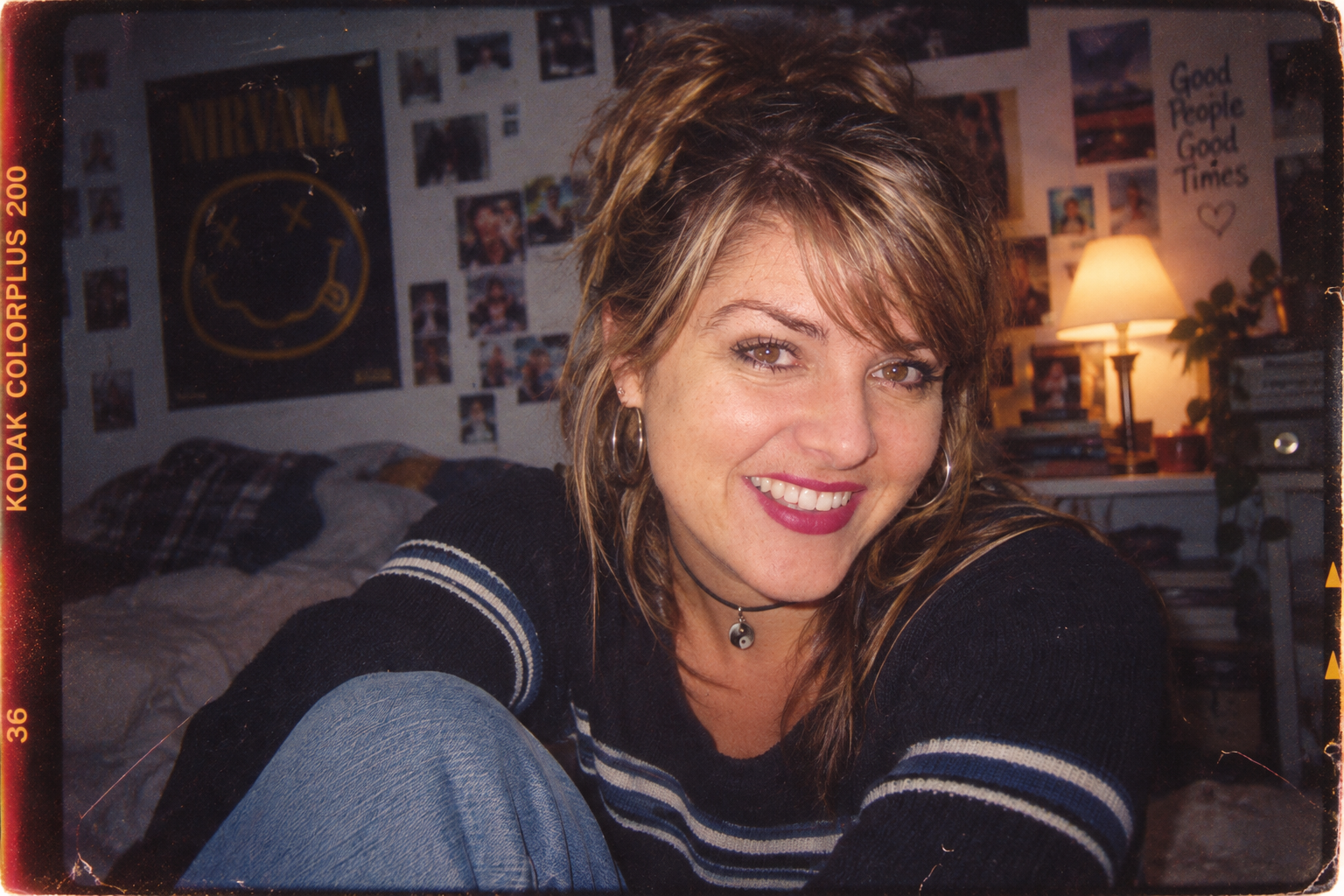
A convincing 1990s photo is not just a modern portrait with heavy grain and a date stamp added on top.
The photographs people actually kept in albums were often imperfect in very specific ways: direct on-camera flash, slightly soft focus, uneven exposure, consumer film color, casual framing, modest grain, and completely ordinary surroundings. This prompt recreates those qualities while avoiding exaggerated “retro” stereotypes.
Authentic 1990s Point-and-Shoot Snapshot Prompt
Use the uploaded portrait as the exact identity reference for the person. Transform the image into a believable candid photograph taken in the 1990s with an ordinary consumer 35mm point-and-shoot film camera. The final image should look like a genuine photograph discovered in an old family photo album or envelope of developed film prints. Do NOT make it look like a modern fashion shoot with a retro filter applied. SUBJECT PRESERVATION: Preserve the person’s recognizable: – Facial features – Face shape – Skin tone – Ethnicity – Eye shape – Nose – Smile – Distinctive facial characteristics Keep the person clearly recognizable as the same individual. Do not excessively beautify the face. Do not create modern beauty-retouching, perfect skin, artificial symmetry, or hyper-detailed pores. If requested, the subject may appear as a younger ADULT version of themselves while keeping the same recognizable identity. Age direction: [KEEP CURRENT AGE / YOUNGER ADULT] If making the subject younger, adjust age naturally rather than replacing them with a different-looking person. HAIR: Give the subject a believable hairstyle appropriate to an ordinary person photographed during the 1990s. Keep it natural and wearable rather than costume-like. Possible qualities include: – Softly layered hair – Natural bangs – Loose face-framing pieces – Simple ponytail – Messy casual updo – Shoulder-length layers – Subtle volume – Natural highlights where appropriate Avoid exaggerated teased hair or stereotypical decade styling unless specifically requested. WARDROBE: Replace obviously modern clothing with casual, believable clothing that could naturally have been worn in the 1990s. Examples: – Simple fitted T-shirt – Striped knit top – Casual sweater – Denim – Plain tank top – Cardigan – Relaxed button-down shirt – Simple jacket Use ordinary colors and fabrics. Avoid obvious costume styling. Do not automatically add neon clothing, windbreakers, oversized logos, extreme patterns, or themed retro accessories unless specifically requested. ACCESSORIES: Replace obviously modern jewelry or accessories when necessary. Use subtle period-appropriate details such as: – Small hoop earrings – Simple studs – Thin necklaces – Modest chokers – Fabric hair ties – Simple watches – Understated rings Accessories should feel like something the person actually owned rather than props chosen for a 1990s costume party. CAMERA: Simulate an inexpensive consumer 35mm point-and-shoot camera. The photograph should have characteristics such as: – Built-in direct flash – Slightly soft lens rendering – Modest film grain – Limited dynamic range – Slight edge softness – Imperfect focus – Subtle lens haze – Occasional red-eye only when physically plausible – Mild color shifts – Imperfect white balance – Consumer-film contrast – Slight exposure inconsistency The camera should NOT behave like a modern professional DSLR or smartphone. FLASH: Use realistic direct on-camera flash. The flash should create: – Brighter skin on the camera-facing side – Slightly flattened facial lighting – Quick falloff into the background – Harder small shadows behind nearby objects – Occasional bright highlights on skin – Mild reflective glare on shiny materials The flash should feel imperfect but believable. Do not create sophisticated studio lighting. ENVIRONMENT: Place the subject in a normal everyday setting appropriate for a casual snapshot. Possible environments: – Bedroom – Living room – House party – Restaurant – School event – Family gathering – Friend’s apartment – Hallway – Casual vacation – Backyard – Small café The environment should feel lived-in and ordinary. Include subtle background details such as furniture, framed pictures, lamps, posters, shelves, curtains, household clutter, other people partially visible, tables, cups, or bags. Do not turn the setting into an exaggerated period-themed set. COMPOSITION: Make the photograph feel casually taken by a friend or family member. Use imperfect amateur composition. Allow: – Slightly tilted framing – Uneven headroom – Awkward but believable cropping – Subject slightly off-center – Partially cropped background people – Casual body position – Spontaneous facial expression Avoid polished editorial composition. The image should feel like someone raised a small camera, pressed the shutter, and moved on. FILM CHARACTERISTICS: Recreate subtle physical characteristics of consumer film photography. Include: – Fine-to-moderate grain – Subtle color noise – Slightly muted fine detail – Gentle softness – Mild warm or green color cast – Uneven saturation – Soft highlight rolloff – Slightly crushed dark areas – Tiny dust particles – Occasional faint scratch – Minor processing imperfections Keep these effects restrained. The image should look old because of the photographic technology, not because someone applied a heavy vintage filter. PRINT QUALITY: The final image may resemble a scanned photographic print. Include subtle: – Paper texture – Soft print sharpness – Edge fading – Mild discoloration – Tiny surface dust – Slight print wear Do not heavily damage the photograph. Do not add huge scratches, extreme fading, burned edges, or artificial grunge unless requested. DATE STAMP: Optional. If enabled, add a small orange or red consumer-camera date stamp near one lower corner. Date: [OPTIONAL DATE] The date should be small and imperfectly rendered like a real camera date imprint. Do not make the date a prominent design element. COLOR: Use believable consumer color film. Skin tones should remain natural but may shift slightly warmer or cooler depending on lighting. Avoid modern teal-and-orange grading, cinematic LUTs, heavy sepia, exaggerated faded colors, or neon retro palettes. The image should feel ungraded. IMAGE QUALITY: Do NOT make the image perfectly sharp. Preserve enough facial detail for recognition while allowing the limitations of inexpensive film photography. The final photograph should feel like a real scanned 4×6 print from the 1990s. MOOD: Casual. Personal. Unpolished. Warm. Ordinary. Nostalgic. Spontaneous. Believable. IMPORTANT: – Preserve the person’s recognizable identity. – Keep the result photorealistic. – Do not make the image look AI-generated. – Do not use modern cinematic lighting. – Do not make skin perfectly smooth. – Do not use extreme film grain. – Do not automatically add VHS effects. – Do not add chromatic glitches. – Do not add neon retro graphics. – Do not create stereotypical 1990s costumes. – Do not turn the image into a fashion editorial. – Do not make every background element obviously 1990s. – Do not make the image intentionally ugly. – Imperfections should come naturally from the camera and film process. – The final result should look like a real photograph someone actually took during the decade. OPTIONAL CREATIVE DIRECTION: Year: [1991 / 1995 / 1998 / ETC.] Age direction: [KEEP CURRENT AGE / YOUNGER ADULT] Environment: [BEDROOM / HOUSE PARTY / RESTAURANT / SCHOOL / VACATION / ETC.] Wardrobe: [KEEP SIMILAR / DESCRIBE] Hairstyle: [AUTOMATIC PERIOD-APPROPRIATE / DESCRIBE] Flash: [DIRECT FLASH / FLASH + AMBIENT LIGHT] Film appearance: [WARM / NEUTRAL / SLIGHTLY COOL] Image condition: [FRESH PRINT / LIGHTLY AGED / OLD ALBUM SCAN] Date stamp: [NONE / DATE] Aspect ratio: [4:3 / 3:2 / 1:1]
What This Prompt Creates
This prompt takes a modern portrait and rebuilds it as though someone genuinely photographed the person with an inexpensive film camera during the 1990s.
The goal is not to scream “LOOK, IT’S THE 90s!”
Instead, the decade comes through in quieter details: the camera technology, casual clothing, hairstyle, direct flash, limited sharpness, background environment, film color, and imperfect composition.
That restraint is what makes the final photograph feel believable.
How to Use It
Upload a clear photograph of the person you want to preserve.
The original photo does not need to look old. A modern smartphone portrait can work because the prompt instructs the AI to rebuild the photographic characteristics around the subject.
Then customize a few variables.
For example:
Year: 1997
Age direction: Younger adult
Environment: Friend’s bedroom during a small gathering
Wardrobe: Dark striped knit top and relaxed denim
Hairstyle: Casual layered updo with face-framing pieces
Flash: Direct flash + weak room lighting
Film appearance: Slightly warm
Image condition: Lightly aged album scan
Date stamp: None
The environment does not need to contain ten obvious decade references. A normal bedroom, restaurant, or living room usually looks much more authentic.
Make It Your Own
House Party Snapshot
Use strong direct flash, people partially cropped in the background, ordinary furniture, drinks on a nearby table, and slightly chaotic framing.
Family Photo Album
Use a living room or restaurant, modest clothing, cleaner composition, softer expressions, and a slightly aged 4×6 print appearance.
Late-90s Bedroom Photo
Add posters, photographs taped to the wall, a bedside lamp, books, casual bedding, and simple everyday clothing.
Vacation Snapshot
Use daylight mixed with fill flash, tourist scenery, slightly overexposed highlights, and inexpensive consumer-film color.
Night-Out Photo
Use a dark restaurant, party, or event environment where the built-in flash brightly illuminates the subject while the background falls into darkness.
Tips for Better Results
The most important instruction is actually what not to do.
If your result becomes too stereotypically retro, add:
“Remove obvious retro styling. Make the environment and clothing feel ordinary for the period rather than intentionally themed around the decade.”
If the image still looks too modern, reinforce:
“Reduce digital sharpness and computational detail. Simulate the optical limitations of an inexpensive consumer 35mm point-and-shoot camera and scanned photographic print.”
If the flash looks too flattering, add:
“Use simple direct built-in camera flash rather than studio-quality portrait lighting.”
The image should not be destroyed with grain either. Real consumer photographs could be surprisingly clean, especially when exposed properly. What usually gives them away is the combination of flash behavior, lens softness, print quality, color response, and imperfect framing.
And unless you specifically want a date stamp, I would usually leave it off. A convincing photo should feel period-correct even without DEC 12 1998 announcing itself in orange letters.
Why This Works
Authenticity comes from combining many small photographic cues rather than one exaggerated visual effect.
Modern digital photography tends to give us extremely sharp details, corrected white balance, wide dynamic range, sophisticated processing, and very clean shadows.
Older consumer photography did not.
By intentionally removing some of that technical perfection, the image begins to feel like a memory rather than a modern photograph wearing a vintage filter.
Final Thought
The best “1990s aesthetic” is often not an aesthetic at all.
It is simply a believable photograph taken with the technology people actually carried at the time.
Less costume.
Less nostalgia filter.
More “someone found this in a box of old photos.”