
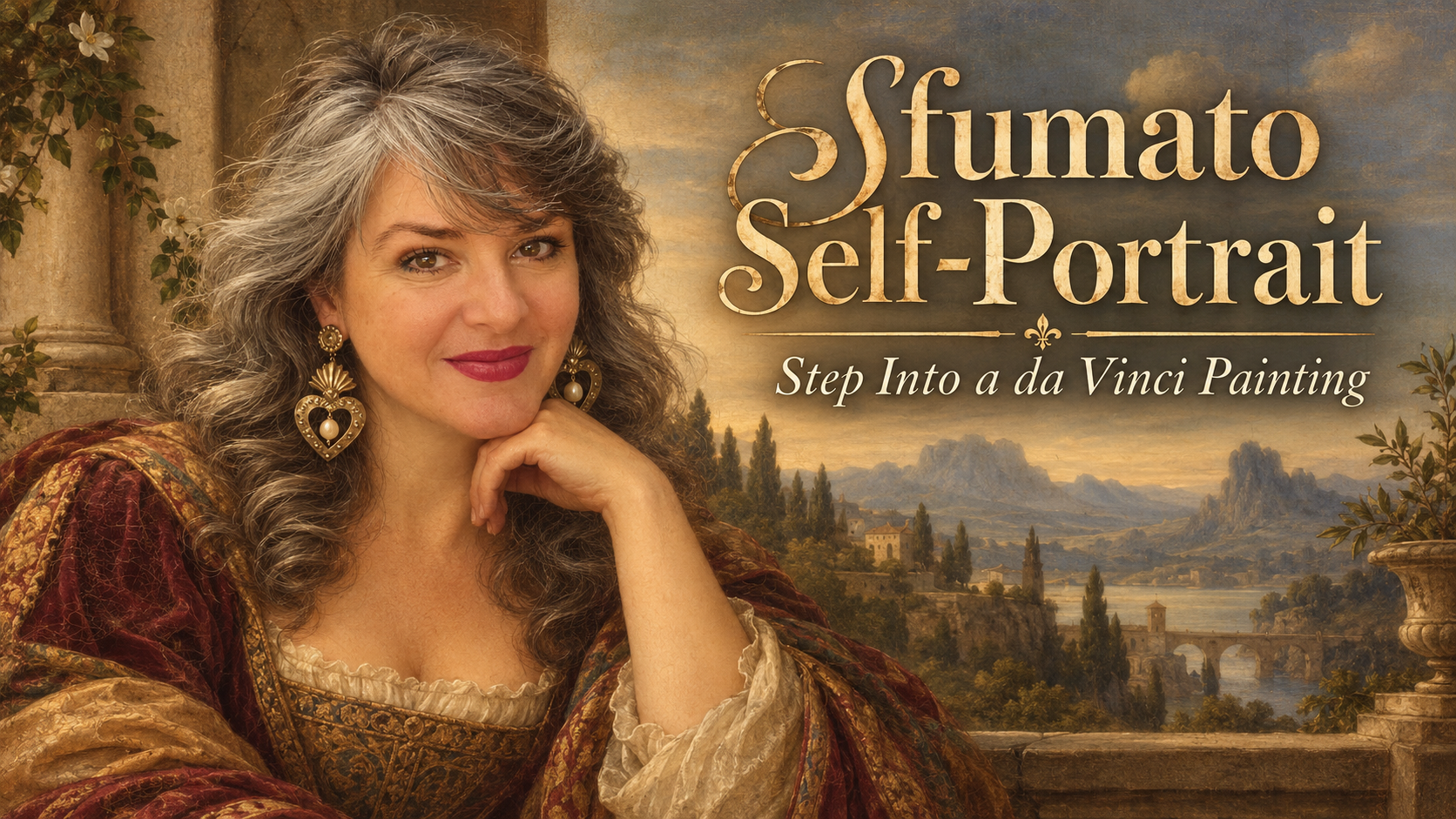
Leonardo da Vinci’s portraits feel alive because their edges rarely shout. Soft transitions between light and shadow create depth, quiet expression and a sense of mystery.
This self-portrait prompt puts you inside an original High Renaissance painting. The emphasis is on painterly sfumato, subtle anatomy and atmospheric landscapes—not copying the Mona Lisa.
Copy the AI Prompt
Using my uploaded photograph as the reference, paint an ORIGINAL half-length Italian High Renaissance portrait inspired by the painting methods of Leonardo da Vinci, especially sfumato, layered translucent glazes, naturalistic anatomy and atmospheric perspective. The sitter must clearly be the same person as the reference: maintain my face shape, age cues, natural skin color, distinctive nose, eyes, smile, hairstyle, hairline and subtle asymmetries. Do not replace my face with a generic Renaissance model or a famous historical sitter. Give me a calm, quietly happy expression and an elegant, natural three-quarter stance; hands posed [HAND POSITION] and clothing [PERIOD-APPROPRIATE WARDROBE] with realistic drapery folds. Paint using warm umber, muted olive, deep sienna and subtle ultramarine shadows. Shape the face with delicate, almost imperceptible transitions from light to shadow; no harsh photographic contours. Add small highlights on the cheekbones, lips and eyes, gentle eyelid shading, softly modeled skin and an old-master wood-panel oil-paint texture with fine brushwork and realistic aged varnish, but avoid exaggerated cracking. Background: [ORIGINAL RENAISSANCE SCENERY], hazy winding river, distant blue-gray hills and quiet architectural hints rendered with atmospheric perspective. Balanced pyramidal composition, lifelike hand anatomy and soft directional window illumination from the upper left. Vertical 4:5 portrait, high-resolution museum-quality artwork. IMPORTANT: create a NEW original painting rather than recreating the Mona Lisa or any specific existing artwork. No modern objects, cameras, photographic lens blur, airbrushed skin, ornate gold text, signatures, labels, watermarks, extra hands or extra figures. The final image should look like a newly discovered masterwork portraying ME, not a stock historical portrait.
What This Prompt Creates
An original portrait of the uploaded person that feels painted on an aged wooden panel: translucent glazes, warm earth pigments, delicately modeled hands, soft smile and distant hazy landscape. The sitter stays recognizable instead of becoming an unrelated historical figure.
How to Use It
1. Upload a sharp image that shows the subject’s face clearly; avoid heavy beauty filters.
2. Specify modest period clothing, a desired hand placement and a calm facial expression.
3. Paste the prompt and generate one painted 4:5 portrait.
4. Check that the face remains recognizably yours and that the result looks painted rather than photographed through a brown filter.
5. Create the blog hero as a separate wide composition, adding the headline in layout software.
Make It Your Own
1. Florentine Scholar — Add books, parchment and a softly lit study, keeping the subject as the focal point.
2. Garden Terrace — Place the sitter before a Tuscan terrace with distant atmospheric blue hills.
3. Merchant Portrait — Use understated velvet garments, elegant hands and a dark olive backdrop.
4. Golden Twilight — Shift the palette to warm golden illumination and deeper chiaroscuro without harsh outlines.
Tips for Better Results
• Describe sfumato as seamless tonal transition around eyelids, cheeks and mouth.
• Preserve individuality—distinctive freckles, age lines and the sitter’s actual hairstyle.
• Favor period-appropriate pigment and textures rather than photographic sharpened detail.
• Do not request a replica of the Mona Lisa composition; make the setting and pose your own.