
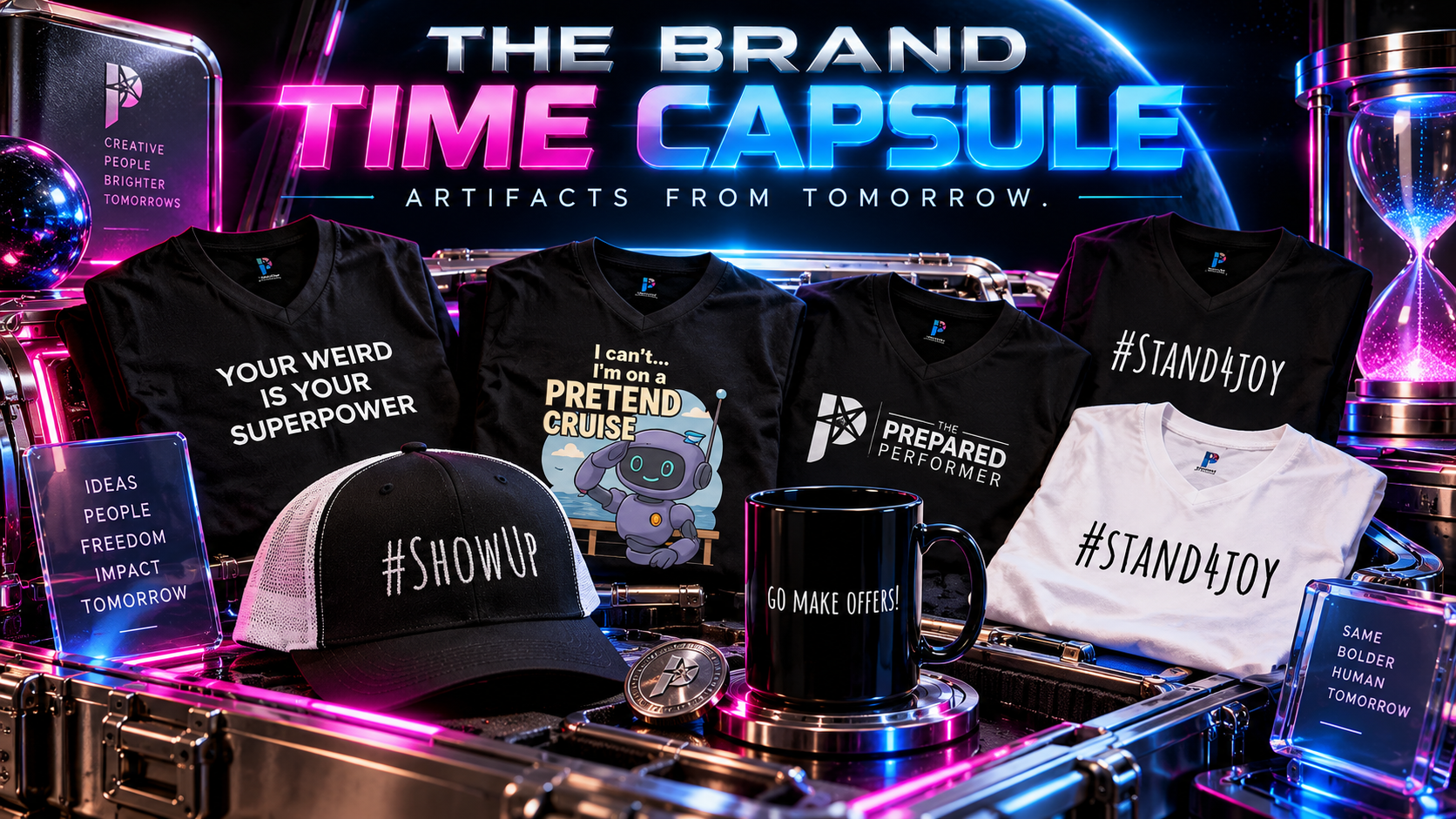
What would your brand look like if someone uncovered it twenty years from now? Not as a screenshot, but as a collection of physical objects worth saving: a package, a ticket, a campaign print, a material sample and a beautifully worn piece of design history.
The Brand Time Capsule turns that idea into a cinematic editorial image. Instead of another flat identity board, you build a tactile future archive that tells a brand story through materials, lighting, scale and carefully connected artifacts.
The Brand Time Capsule: Artifacts From Tomorrow
Create a photoreal, cinematic BRAND TIME CAPSULE: a meticulously art-directed still life showing how one real or fictional brand might be remembered decades in the future. The result should look like a luxury design-magazine cover photographed on a museum conservation table, not a flat moodboard, website mockup, template, app dashboard, or generic sci-fi product render. BRAND NAME / REFERENCE: [brand name and optional uploaded logo or existing brand assets]. BRAND CATEGORY: [coffee / skincare / fashion / creative studio / technology / other]. CORE PRODUCT OR SERVICE: [one unmistakable hero item]. BRAND PERSONALITY: [three adjectives, e.g., playful, precise, rebellious]. CURRENT COLOR PALETTE: [two main colors plus one restrained accent]. FUTURE YEAR: [2035 / 2045 / 2075 / custom]. MATERIAL LANGUAGE: [recycled paper, translucent resin, brushed aluminum, woven fabric, glass, ceramic, etc.]. FORMAT: [4:5 vertical / 16:9 horizontal / 1:1 square]. OPTIONAL BRAND ASSETS: [upload original logo, packaging, typography or product reference images]. SCENE: Arrange a coherent collection of six to eight physical artifacts as if archivists have just opened a time capsule from the selected future year. One oversized hero artifact anchors the scene: a beautifully designed future version of the brand’s real product, package, device, book, garment, or signature service object. Around it place a folded campaign poster, embossed identity seal, small packaging prototype, material and pigment samples, a ticket or membership token, a translucent design overlay, and a single archival photograph or contact sheet. Each item must be plausibly manufactured and unmistakably belong to the same brand family. COMPOSITION: Use an immersive, edge-to-edge tabletop installation with dramatic scale changes and asymmetrical visual rhythm. Layer real objects at different heights; let folded papers, clear sheets, ribbons, shadows, small objects, and light spill overlap naturally. Use diagonal pathways and tactile details to guide the eye from the hero artifact through secondary discoveries. Avoid neat equal-sized boxes, heavy outlines, separate card borders, floating UI panels, or a rigid grid. Leave one deliberate pocket of negative space for a headline to be added later. FUTURE DESIGN LANGUAGE: Evolve the existing brand rather than replacing it. Carry its palette, logo silhouette, product shape, or material cues into future artifacts. Make the future feel specific through believable manufacturing innovations: translucent biodegradable shells, refined embossed marks, unusual but feasible closures, smart material textures, precision die-cuts, or new tactile finishes. Avoid generic chrome spaceships, random holograms, cyberpunk cityscapes, and unrelated futuristic symbols. The objects should communicate a credible creative direction, not simply look expensive. LIGHT AND CAMERA: Shoot like a premium editorial still life on a real set with a 50 mm lens, slightly elevated three-quarter angle, crisp hero object, shallow but readable depth of field, realistic contact shadows, visible paper fibers, tiny scratches, ink registration, fabric weave, and controlled specular highlights. Mix a broad soft key light with one directional practical glow motivated by the scene. Allow the accent color to illuminate selective surfaces, but keep whites neutral and materials legible. Use natural perspective, convincing reflections, and filmic contrast. GRAPHIC DETAILS: Show layered die-cut shapes, micro-patterns, abstract brand marks, packaging silhouettes, subtle archival numbering, and a few intentional visual annotations as physical marks on the table or tracing paper. Do not rely on the model to spell the brand name correctly. If a precise logo or headline is required, reserve clean placement space and apply the supplied vector artwork or real typography afterward in a design editor. If uploaded brand assets are available, preserve their recognizable shapes and colors without inventing a replacement identity. QUALITY CONTROL: Every artifact should be individually distinct but visually connected. Maintain correct object scale, believable folds and hinges, logical packaging construction, accurate reflections, natural contact points, coherent lighting, and consistent material behavior. No extra hands, warped typography, random gibberish labels as focal points, fake watermarks, duplicated packages, disconnected floating objects, impossible shadows, or oversaturated glow. The final result should feel discovered, collectible, tactile, imaginative, and ready for a premium editorial campaign.
What This Prompt Creates
This prompt creates a richly layered, photoreal still life of six to eight coordinated brand artifacts from an imagined future year. One hero product anchors the composition while packaging prototypes, identity seals, printed ephemera, translucent overlays and material samples reveal how the brand could evolve. The result works for creative-direction pitches, speculative rebrands, portfolio projects, launch teasers and design-focused social content.
How to Use It
1. Choose a real or fictional brand and fill in its product category, hero item, three personality words, palette and future year.
2. Upload the existing logo, product and packaging references if you need continuity. Use an original fictional brand when you want complete creative freedom.
3. Paste the full prompt into your image generator, choose a 4:5 image for social or 16:9 for a featured image, and generate several compositions.
4. Review the hero item’s shape, material realism, coherent brand colors and physically plausible artifact placement. Regenerate weak details instead of adding more decorative clutter.
5. Add accurate brand typography, logo artwork and final annotations in your design editor; export the finished layout at the intended dimensions.
Make It Your Own
• The Sustainable 2040 Archive — Replace plastic with molded pulp, mycelium textures, pressed botanical pigments, refillable glass and quietly optimistic daylight.
• The Luxury 2075 Collection — Use satin metal, frosted crystal, sculpted ceramic, fine embossing and deep directional lighting with a single jewel-tone accent.
• The Playful Pop-Future Kit — Build a bright, tactile collection of modular stickers, collectible tokens, folded mini-posters and unusual soft-touch packaging.
• The Analog Tomorrow Edition — Imagine a future that loves print: risograph textures, archival paper, rubber stamps, fabric patches, contact sheets and warm tungsten light.
Tips for Better Results
• Keep one unmistakable hero object. The supporting artifacts should enrich the story, not compete for attention.
• Repeat the brand’s color and shape language across at least three artifacts so the collection feels intentional.
• Name real materials and manufacturing methods. “Translucent resin with an embossed seal” is more useful than “futuristic.”
• Ask for overlapping physical layers, asymmetric rhythm and realistic contact shadows instead of a sterile grid or framed cards.
• Leave accurate text and logo application for post-production; AI-generated microtype is often unreliable.
• Check material behavior: paper bends, glass refracts, metal reflects and every object must rest or hang plausibly.