
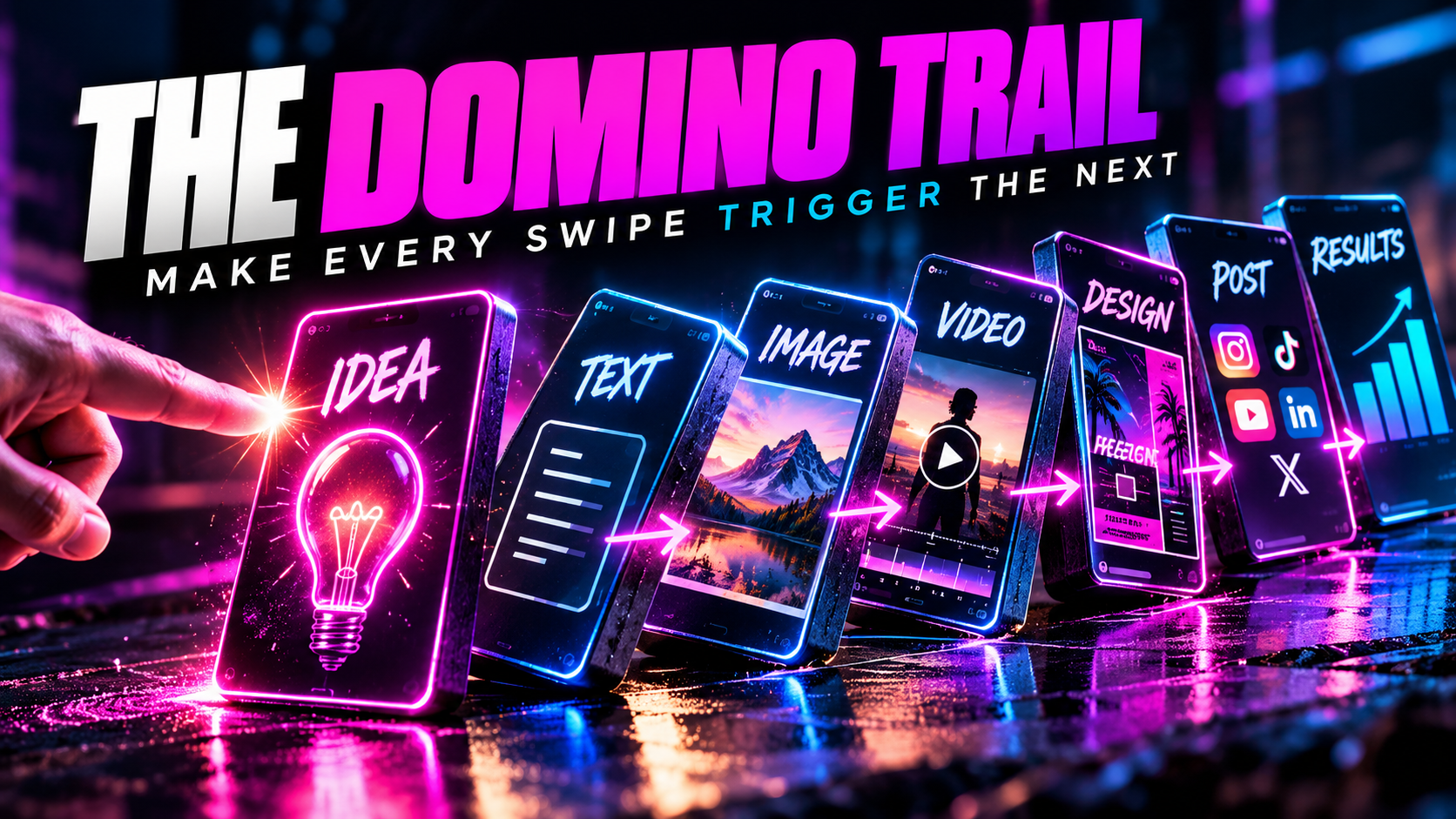
A good carousel makes people swipe. A great one makes them feel like they have to see what happens next. The Domino Trail turns five individual posts into one connected chain reaction, with giant sculptural dominoes carrying the story from slide to slide.
Instead of repeating the same layout five times, this prompt uses motion, scale, and physical continuity to create momentum. Each slide has its own purpose, but the entire sequence feels like one beautifully art-directed photograph unfolding in chapters.
The Domino Trail: Make Every Swipe Trigger the Next
Create a premium, visually intricate FIVE-SLIDE INSTAGRAM CAROUSEL campaign called “THE DOMINO TRAIL”: a single continuous chain reaction of sculptural, oversized domino objects that visually travels from slide 1 through slide 5. Every swipe should feel like the next physical moment of the same event. The visual language is editorial, kinetic, tactile, bold, and camera-believable, with NO borders, NO boxed cards, NO rigid grids, and NO generic flat infographic styling. CUSTOMIZE THESE INPUTS: BRAND OR CREATOR: [brand name or creator, optional]. CORE MESSAGE: [one concise message, e.g., “Small ideas create big momentum”]. AUDIENCE: [entrepreneurs / creators / designers / educators / other]. HERO OBJECT: [oversized ceramic domino slabs / translucent acrylic tiles / matte painted wood / other]. COLOR PALETTE: [electric cobalt blue, warm coral, pale butter yellow, charcoal black, and small polished-chrome accents]. ENVIRONMENT: [infinite charcoal photo studio with sculptural floor / architectural gallery / sunlit brutalist courtyard]. ACCENT MATERIALS: [brushed chrome / colored glass / folded paper / confetti]. OUTPUT: [five separate 1080 × 1440 vertical 4:5 images, one per slide]. OPTIONAL REFERENCE: [brand colors, logo, existing campaign imagery, or none]. ONE CONNECTED PHYSICAL WORLD: Build one meticulously art-directed studio installation containing a line of giant human-height domino pieces. Every piece has consistent dimensions, thickness, edge radius, weight, surface finish, and realistic dot inlays. Each tile is a real physical object that casts contact shadows, collides believably with the next tile, and produces a readable domino chain reaction. Use a single visual direction of motion from left to right, with a consistent camera height, lens language, horizon, floor material, and lighting across all five images. Let the domino path curve in depth, snake around architectural elements, and occasionally pass in front of the camera. The movement must feel sequential rather than five unrelated photographs. FIVE-SLIDE STORYBOARD: SLIDE 1 — COVER / THE FIRST PUSH: One enormous upright domino leans toward the next at the instant before impact. Dramatic diagonal composition, bold sculptural silhouette, crisp rim light, visual energy and strong headline-safe negative space in the upper-left. Reserve room for an editorial title added in post: “THE DOMINO TRAIL”. One tiny directional arrow or trail of falling dust may point toward the right edge. The chain must visibly continue off-canvas. SLIDE 2 — WHAT IT CREATES / THE REACTION: The first three giant dominoes fall in sequence, with the nearest slab sharply frozen mid-impact, a faint puff of floor dust, believable collision points, and distant tiles waiting to fall. The path enters from the left edge where slide 1 ended and exits to the right. Reserve readable space for a short benefit statement. SLIDE 3 — TECHNIQUE / THE MOMENTUM: A low-angle hero view of the domino line bending around a curved plinth. Show one tile pushing another, with tiny tactile cues—scraped paint, brushed edge reflections, surface microtexture, dust, realistic floor shadows. The chain must remain physically coherent and connected. Leave a text-safe area for three short instructional callouts. SLIDE 4 — VARIATIONS / FOUR MATERIAL WORLDS: Show one coherent domino installation transitioning gradually through four clearly legible material treatments along the SAME continuous path: matte painted ceramic, translucent acrylic, walnut wood, and polished chrome. Use overlapping foreground-to-background changes, not four boxed quadrants. Keep camera logic, direction, scale, and lighting unified. Reserve a clean side zone for four short labels. SLIDE 5 — CTA / THE BIG REVEAL: The final domino falls and activates an enormous sculptural burst of brand-color paper ribbons, light-catching particles, and small geometric objects. The finale must look like a practical high-speed photograph rather than a random CGI explosion. The domino line enters from the left, and the burst guides the eye toward a large negative-space area reserved for the CTA “COMMENT “PROMPT””. The brand message is the emotional payoff. ART DIRECTION: Complex full-bleed editorial compositions with dynamic scale changes, strong diagonal flow, intentional occlusion, dramatic depth, macro foreground details, architectural midground, and clean negative space for typography. Use a 28–35 mm editorial camera feel for wide scenes, a 50 mm feel for close details, f/5.6–f/8-like clarity for important objects, and physically plausible high-speed flash freezing where dominoes collide. Primary light is a broad cool studio source from camera left; warm coral bounce from the opposite side; controlled chrome speculars. Maintain a restrained but vivid color system. Allow rich texture, selective motion streaks on nonessential dust, and tack-sharp hero objects. The design should feel like an expensive creative campaign, not a template. CONTINUITY AND PRODUCTION RULES: Plan all five slides together before rendering. If the image generator supports reference images, use the completed previous slide as a reference for the next and match the entering/exiting tile positions. Keep each domino’s pips, edge shape, colors, material, and direction consistent from shot to shot. Generate five SEPARATE images at exactly 1080 × 1440 pixels each; do not output a five-panel collage. If exact size is unavailable, render at 4:5 and export to 1080 × 1440 without stretching. Place important elements inside a generous safe zone, but extend photography to every outer edge. Add final typography and any accurate brand logo in the layout editor after generation; do not rely on AI to spell small text correctly. AVOID: Frames, visible borders, tiled panels, repeated identical camera angles, floating dominoes, impossible collisions, inconsistent shadows, duplicate tiles, plastic-looking surfaces, warped pips, nonsensical motion direction, random flying objects, fake logos, unreadable embedded text, watermarks, and empty minimalist layouts. QUALITY CHECK: The five images should feel like consecutive frames of ONE elaborate physical chain reaction. A viewer must understand what falls first, what causes the next movement, and how the finale is earned. Every image must work on its own as a striking editorial composition and together as a coherent, high-energy swipe experience.
What This Prompt Creates
The result is a cinematic five-slide social-media story built around one impossible-to-ignore physical idea: a line of oversized dominoes falling in sequence. The first slide creates anticipation, the middle slides reveal the chain reaction and its visual logic, and the final slide delivers a dramatic payoff.
The look combines architectural product photography, editorial art direction, high-speed action, and tactile materials. Colored ceramic, acrylic, walnut, and chrome provide texture and variation without breaking the overall visual system. Each composition has intentional negative space for headline overlays, so the design stays legible on a phone.
Because the domino trail moves continuously from one edge to the next, the carousel rewards swiping. Use it for a campaign about momentum, habits, launches, collaboration, cause and effect, or the power of small actions.
How to Use It
Choose a simple core message first. The strongest version connects the domino effect to something meaningful, such as how one creative idea can spark a campaign or how one small habit can change a workflow. Keep the headline short enough to read at mobile size.
Customize the brand palette, materials, environment, and audience in the prompt. Generate the first slide with the desired camera, lighting, and physical domino dimensions, then use it as a visual reference for the following slides whenever your image tool supports references or image editing.
Render each slide separately at a 4:5 ratio, ideally 1080 × 1440. Match the point where the domino path exits one slide to the point where it enters the next. Preserve camera height, tile thickness, surface finish, shadows, and the left-to-right direction of movement.
Finally, add headlines, labels, the brand logo, and the CTA in your design editor. Do not ask the image model to generate small copy. Preview all five images at phone size, then swipe through them in order to confirm the visual flow.
Make It Your Own
1. The Creative Spark — Use electric yellow ceramic tiles in a midnight-blue studio. Every impact releases a controlled burst of colored paper, with the final tile revealing a launch message.
2. The Sustainable Shift — Replace synthetic finishes with reclaimed wood, cork, recycled glass, and natural fibers. Shoot in a daylight-filled gallery with soft shadows and muted botanical greens.
3. The Luxury Chain — Use smoked glass, polished brass, deep burgundy lacquer, and a dark marble floor. Keep the collisions elegant and the finale minimal, with exquisite highlights rather than confetti.
4. The Learning Curve — Use chalk-painted dominoes in a bright classroom-sized set. Each falling tile represents a step in a process, while oversized arrows and short educational labels are added later in the editor.
Tips for Better Results
Design the chain reaction as a storyboard before generating. Sketch the path across five vertical rectangles and mark the exact entrance and exit points. This prevents the sequence from feeling like five unrelated domino photographs.
Make the physics credible. Dominoes should touch at realistic impact points, lean in a consistent direction, and cast accurate contact shadows. One convincing collision is stronger than twenty random airborne pieces.
Use dramatic depth rather than decorative borders. Let tiles overlap the foreground, turn corners in the midground, and recede toward a believable vanishing point. Layered shadows, small dust clouds, and controlled reflections add complexity without clutter.
Keep a consistent material and lighting recipe. If a cobalt tile looks like ceramic on slide 1, it should not suddenly become transparent plastic on slide 2. Save a reference image or a small materials sheet before rendering the full set.
Reserve space for typography but build the photographic background edge to edge. Keep final copy brief, check legibility at mobile size, and avoid placing important words over the collision point.