
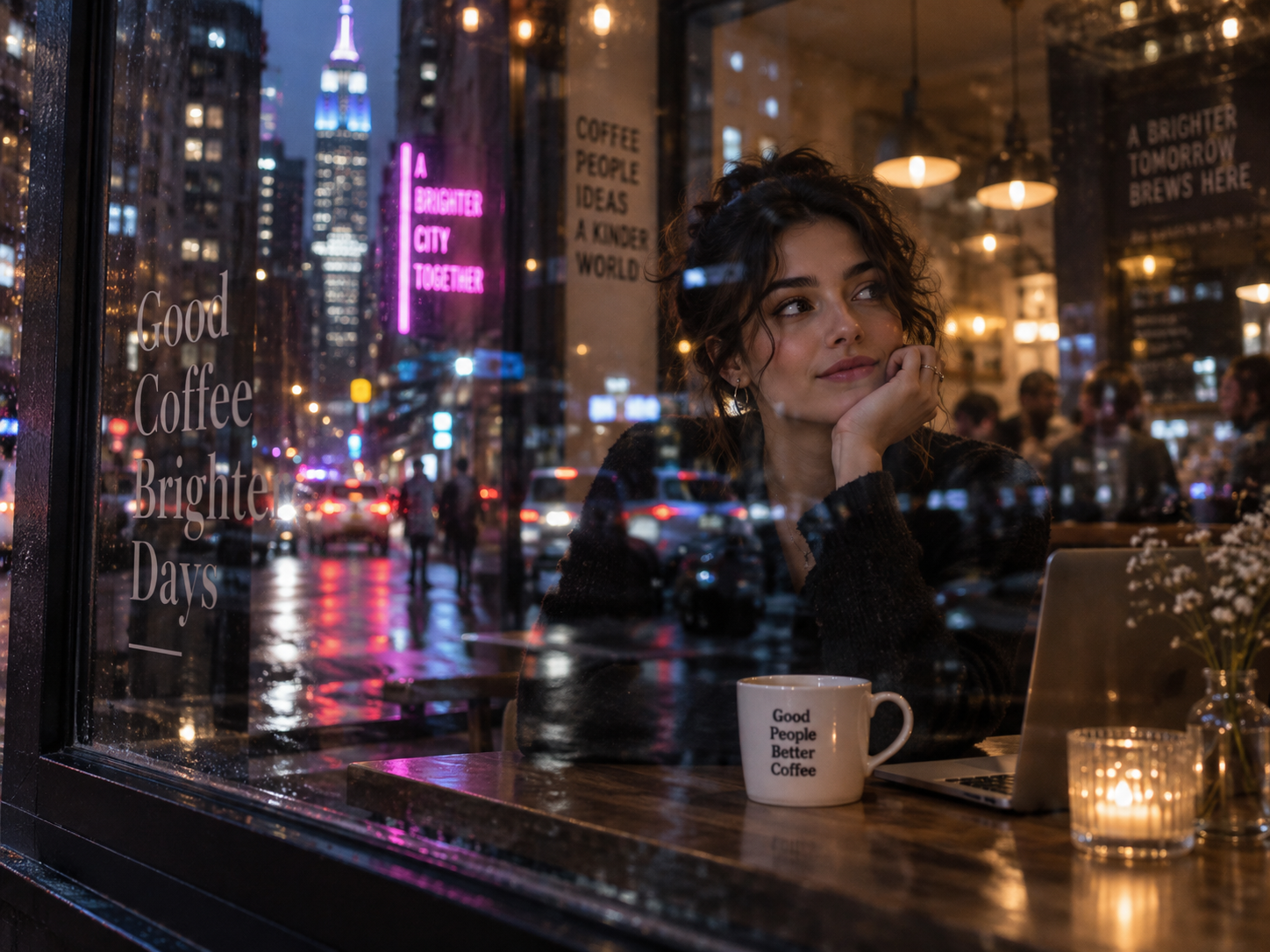
Reflections can instantly make a portrait feel more cinematic, but AI often treats them like a transparent image pasted over someone’s face. The result can quickly look more like a double exposure than an actual photograph taken through glass.
This prompt approaches the scene like a real photographer would. It places a physical window between the camera and the subject, then builds believable city reflections, glare, lighting, depth, and atmosphere around the person while keeping their face recognizable and natural.
Cinematic Window Reflection Portrait Prompt
Use the uploaded portrait as the exact identity reference for the person. Transform the source image into a cinematic environmental portrait photographed THROUGH a real glass window. The final image should look like an intentional photograph captured by a professional photographer, not like a digital double-exposure effect. SUBJECT PRESERVATION: Preserve the person’s exact recognizable: – Facial features – Face shape – Skin tone – Ethnicity – Hairstyle – Age – Body proportions – Distinctive characteristics Do not beautify, reshape, or reinterpret the face. Keep realistic skin texture, pores, hair strands, and natural imperfections. SCENE: Place the subject naturally beside a large window in: [ENVIRONMENT] Examples: – Late-night café – Train – Hotel – Restaurant – Apartment – Taxi – Airport lounge – Storefront Photograph the subject from OUTSIDE or THROUGH the glass. The glass must physically exist between the camera and the subject. WINDOW REFLECTIONS: Create realistic environmental reflections across the glass. Possible reflections include: – City lights – Illuminated signs – Passing vehicles – Street lamps – Building windows – Pedestrians – Traffic lights – Trees – Interior lamps – Distant architecture The reflections must follow the angle, perspective, brightness, and physical behavior of real glass. Do not simply overlay random objects across the subject. FACE VISIBILITY: Keep the person’s face clearly recognizable. Allow reflections to cross portions of the face naturally, but avoid placing strong reflections directly over both eyes. Use darker or quieter areas of reflection around important facial features. The subject should remain the emotional focal point. GLASS DETAILS: Include subtle physical characteristics of real glass where appropriate: – Faint glare – Soft light streaks – Tiny dust particles – Subtle fingerprints – Slight haze – Condensation near the edges – Gentle internal reflections Keep these details understated. LIGHTING: Use cinematic motivated lighting. Light the subject primarily from believable sources within the environment. Allow reflected exterior light to introduce subtle secondary colors onto the subject. Maintain realistic highlights and shadows. DEPTH: Create multiple visual layers: 1. Camera 2. Reflections on the glass 3. Physical glass surface 4. Subject 5. Interior environment behind the subject These layers should produce convincing photographic depth. CAMERA: Simulate professional full-frame photography. Lens: 50mm or 85mm Aperture: approximately f/1.8 to f/2.8 Use shallow but believable depth of field, natural optical bokeh, realistic exposure, subtle film grain, and balanced dynamic range. COMPOSITION: Use reflections to frame the subject and guide attention toward the face. Include intentional negative space. Avoid centering every element perfectly. The image should feel candid and observational, as though a photographer noticed a beautiful moment through the window. MOOD: Cinematic. Atmospheric. Intimate. Quiet. Editorial. Photographic. Emotionally grounded. IMPORTANT: – Preserve the person’s identity. – Do not create a second face in the reflection. – Do not duplicate the subject. – Do not create impossible reflections. – Do not make the reflection equally sharp as the subject. – Do not cover the entire face with bright signage. – Do not turn the image into a surreal double exposure. – Keep the physics of the glass believable. – Maintain realistic human anatomy. – The finished image must look photographed rather than digitally composited. OPTIONAL CREATIVE DIRECTION: Environment: [LATE-NIGHT CAFÉ / TRAIN / HOTEL / TAXI / RESTAURANT / ETC.] Time: [GOLDEN HOUR / BLUE HOUR / NIGHT / RAINY NIGHT] Mood: [ROMANTIC / MELANCHOLIC / LUXURIOUS / URBAN / MYSTERIOUS / WARM] Reflection source: [CITY LIGHTS / NEON SIGNS / TRAFFIC / SUNSET / ARCHITECTURE] Wardrobe: [KEEP ORIGINAL / DESCRIBE WARDROBE] Color direction: [WARM / COOL / TEAL AND AMBER / MUTED / NATURAL] Aspect ratio: [4:5 / 3:2 / 16:9 / 1:1]
What This Prompt Creates
This prompt turns an ordinary portrait into an atmospheric photograph that appears to have been captured through a real window.
Instead of treating reflections as a graphic overlay, the scene is constructed in physical layers. The reflections sit on the glass closest to the camera, the person remains behind it, and the interior environment continues farther into the background.
The result works especially well for editorial photography, lifestyle campaigns, album artwork, cinematic portraits, fashion photography, and personal branding.
How to Use It
Upload a clear portrait where the person’s main facial features are visible, then paste the prompt.
Next, customize the optional creative direction at the bottom.
For the café example:
Environment: Late-night café
Time: Rainy night
Mood: Warm, quiet, cinematic
Reflection source: City lights, passing traffic, storefront illumination
Wardrobe: Keep original
Color direction: Warm interior with cool exterior reflections
Aspect ratio: 4:3
You do not need to describe every reflection manually. Giving the AI a believable environment usually produces more natural results than trying to control every light source individually.
Make It Your Own
Rainy Taxi Portrait
Place the subject in the back seat of a taxi with rain-speckled glass, passing storefront lights, traffic signals, and colorful urban reflections.
Golden-Hour Train
Photograph the subject through a train window with warm sunset reflections, blurred countryside, soft interior lighting, and nostalgic film tones.
Luxury Hotel
Use clean architectural reflections, warm chandeliers, dark glass, sophisticated styling, and restrained highlights for a premium campaign aesthetic.
Late-Night Café
Combine warm interior lamps with cooler street reflections, passing headlights, light rain, and shallow depth of field for an intimate film-still look.
Urban Fashion Editorial
Use stronger architectural reflections, skyscraper glass, dramatic wardrobe, cool color grading, and a more graphic composition.
Tips for Better Results
Start with a portrait where the eyes, nose, mouth, and overall facial structure are clearly visible. The stronger the source image is, the easier it is for the model to preserve identity.
Reflections tend to look best when there is a contrast between the interior and exterior environments. A warm café against a cool nighttime street naturally creates separation between the person and the reflected city.
If the reflections become too strong, add:
“Reduce the reflection brightness and opacity by approximately 40%. Keep the subject’s face as the strongest area of visual contrast.”
If the image begins looking like a double exposure, add:
“The reflections must physically exist on a pane of glass positioned between the camera and subject. Do not overlay a second image directly onto the portrait.”
Keep recognizable text out of the reflected environment unless it is essential. Colored signage and abstract illuminated shapes generally look much more believable than AI-generated storefront copy.