
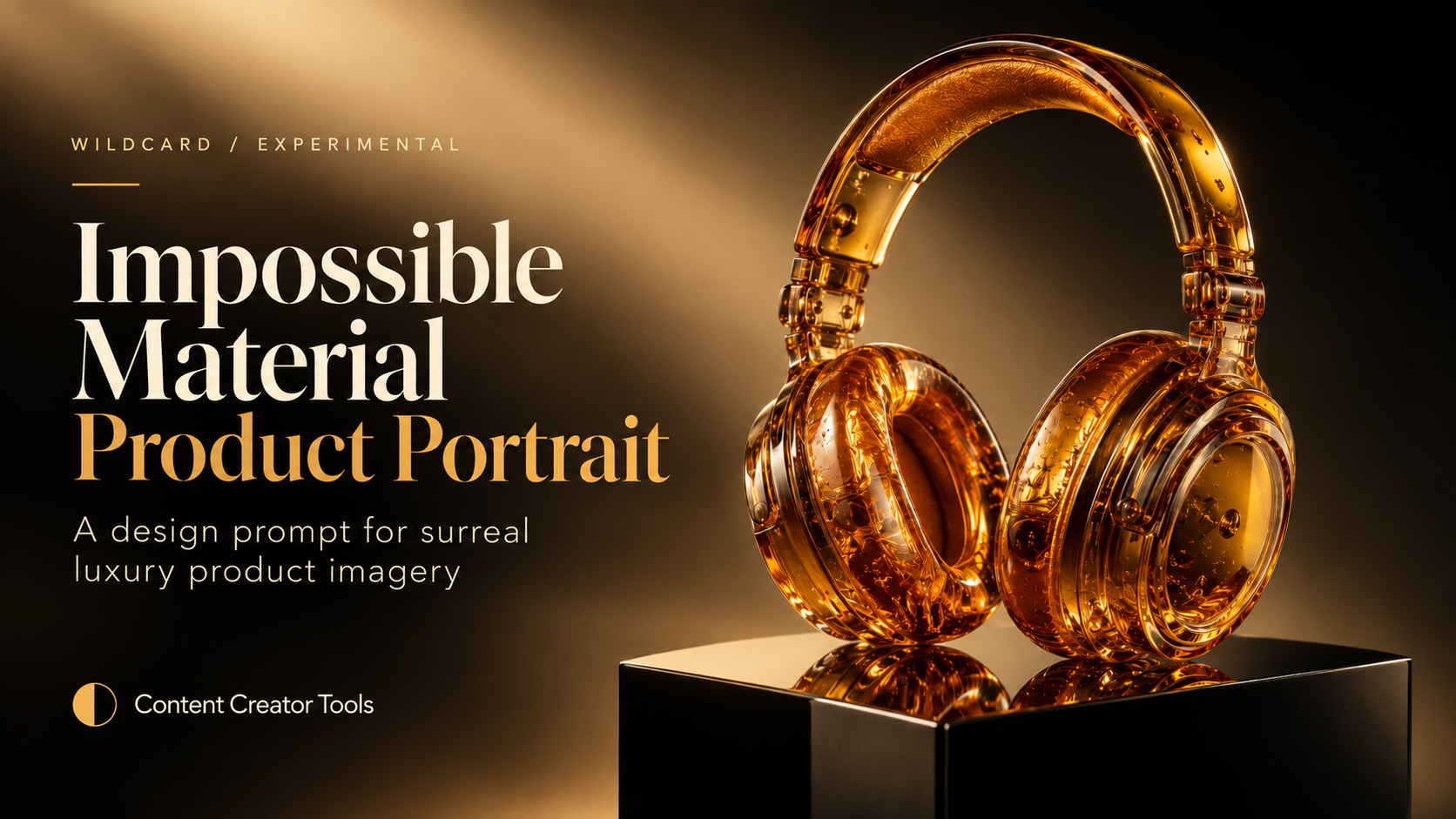
AI gets much more interesting when you stop asking it to simply photograph things that already exist. This prompt keeps the visual language of premium product photography but introduces one deliberately impossible detail: the product’s material.
The trick is restraint. Instead of turning the entire scene surreal, the studio, lighting, camera, and product construction remain believable. That contrast makes the impossible material feel strangely convincing and gives you an image that can stop a scroll without screaming “AI generated.”
Impossible Material Product Portrait Prompt
Create a high-end experimental product portrait featuring [OBJECT] completely reimagined as if it were physically constructed from [IMPOSSIBLE MATERIAL]. Preserve the object’s recognizable silhouette, proportions, functional components, seams, buttons, hinges, openings, and construction details. The transformation should affect its material, not destroy its original design. The [IMPOSSIBLE MATERIAL] must behave convincingly according to its physical properties. Show realistic transparency, translucency, refraction, reflections, texture, surface imperfections, subsurface scattering, liquid behavior, fibers, crystals, melting, condensation, or internal structures wherever appropriate. Place the object on [SURFACE / PEDESTAL] inside a sophisticated commercial photography studio. Background: [BACKGROUND DESCRIPTION], minimal and uncluttered with generous negative space. Lighting: premium advertising photography with one large directional key light, subtle rim lighting, controlled highlights, realistic contact shadows, and physically believable interaction between the light and the unusual material. Camera: professional full-frame commercial photography, 85mm lens, slightly low three-quarter product angle, shallow but controlled depth of field, tack-sharp focus on the main object. Composition: one dominant hero object, centered or slightly off-center, deliberate negative space, strong silhouette, editorial luxury-advertising aesthetic. Color direction: [COLOR PALETTE]. Mood: sophisticated, surreal, tactile, intriguing, expensive, art-directed rather than chaotic. The final image should initially look like a genuine luxury product campaign. Only after looking closer should the viewer realize the product could never actually exist in this material. Prioritize believable material physics, realistic construction, sophisticated lighting, tactile detail, photographic realism, and visual restraint. Avoid fantasy scenery, excessive particles, random decorative objects, distorted product geometry, melted silhouettes unless specifically requested, floating components, extra objects, illegible branding, text overlays, artificial CGI-looking surfaces, oversaturated colors, and generic AI surrealism. Ultra-detailed commercial product photography, photorealistic, physically based materials, realistic optics, premium campaign art direction, high resolution.
What This Prompt Creates
This prompt creates a surreal commercial product portrait where a recognizable everyday object is reconstructed from a material it could never realistically use.
Think glass headphones, a handbag woven from living moss, a sneaker carved from ice, a camera made from polished obsidian, or a game controller formed from translucent gummy candy.
Because the prompt preserves the object’s original construction, the result still reads as product design rather than abstract AI art.
How to Use It
Start with [OBJECT] and choose something with an instantly recognizable silhouette. Headphones, sneakers, watches, cameras, chairs, bottles, keyboards, sunglasses, and bags work especially well.
Then replace [IMPOSSIBLE MATERIAL] with something visually interesting. Be specific. “Glass” works, but “thick translucent amber glass with tiny trapped air bubbles” gives the model much more to work with.
Choose a simple pedestal, background, and limited color palette. The stranger the material becomes, the simpler the rest of the image should be.
Finally, generate several versions while changing only the material. This makes it easy to turn one concept into a consistent experimental series.
Make It Your Own
Frozen Edition: Turn the object into crystal-clear ice with trapped bubbles, hairline fractures, condensation, and tiny melting droplets collecting on the pedestal.
Organic Edition: Construct it from living moss, tiny leaves, roots, and damp organic fibers while preserving every functional component.
Liquid Metal Edition: Use mirror-polished mercury-like metal with controlled flowing edges, liquid reflections, and a perfectly recognizable silhouette.
Candy Edition: Rebuild the product from translucent gummy material with subtle imperfections, internal bubbles, soft deformation, and glossy highlights.
Geological Edition: Carve the object from a single piece of obsidian, marble, quartz, or another mineral with natural veins and crystalline inclusions.
Tips for Better Results
Choose one impossible idea per image. Glass headphones on a floating lava pedestal surrounded by butterflies in space might sound creative, but at that point the product has filed for visual bankruptcy.
Describe how the material behaves, not just what it is. Ice should refract light and develop condensation. Fabric should fold and compress. Glass should produce reflections and caustics. Moss should have irregular fibers and organic variation.
Keep recognizable construction details in the prompt. Asking the model to preserve buttons, hinges, stitching, vents, seams, or handles prevents the transformation from becoming an unrelated sculpture.
Use restrained studio environments. Simple backgrounds make unusual materials feel more premium and give viewers enough visual breathing room to notice the transformation.
For a series, keep the camera position, lighting, backdrop, and object identical while changing only the material. You’ll get a much stronger carousel or campaign than five completely unrelated surreal images.