
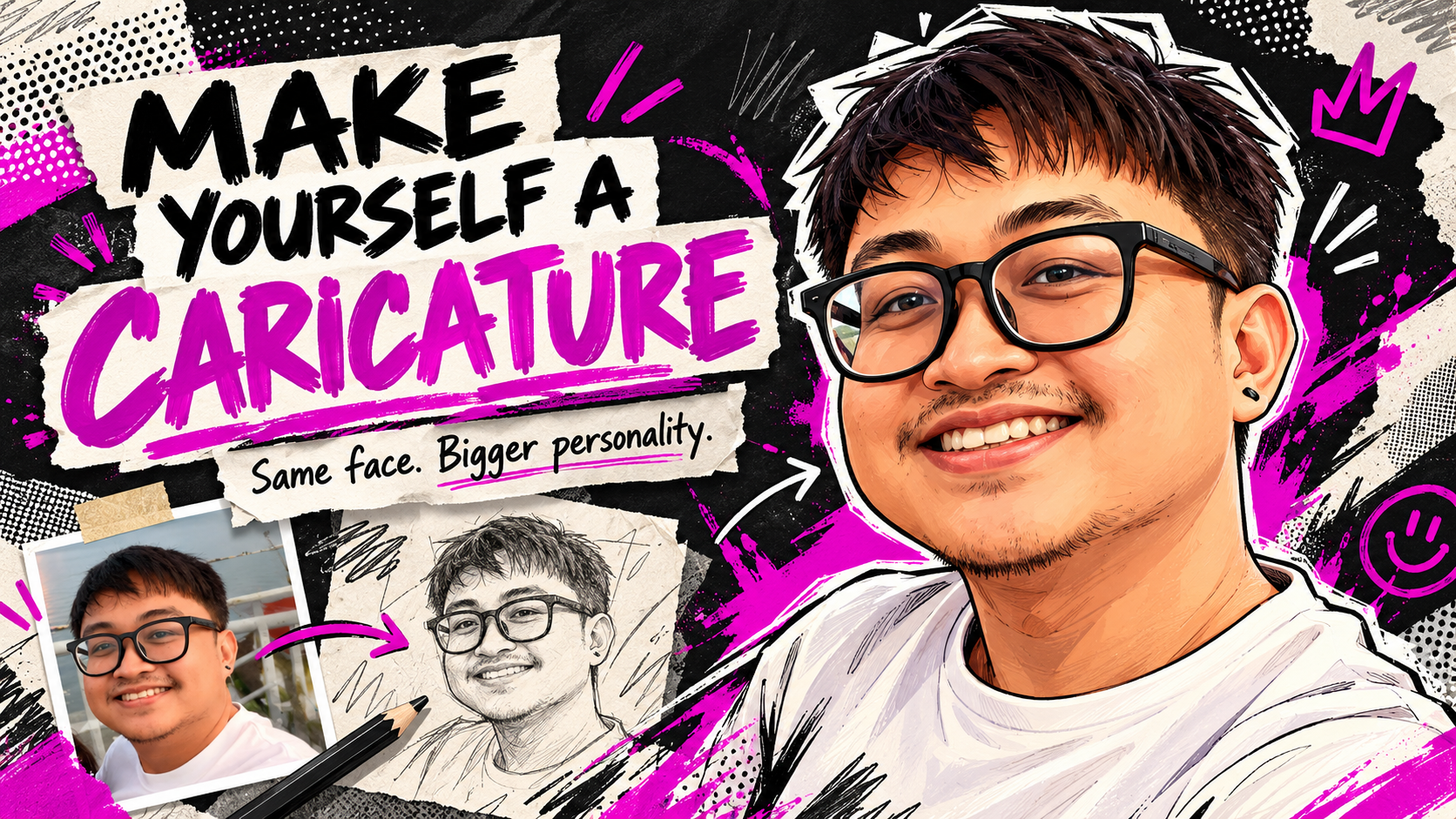
A good caricature exaggerates what makes a face memorable. Maybe it’s an expressive eyebrow, a mischievous smile, an unmistakable hairstyle or the way someone raises one corner of their mouth. The result can be wildly exaggerated and still feel more like the person than a perfectly realistic painting.
With Make Yourself a Caricature, your selfie becomes the starting point for a custom illustrated portrait. The trick isn’t asking AI to make every facial feature enormous. It’s identifying two or three traits that carry the likeness and amplifying them while keeping the remaining features in balance. Think polished editorial illustration, not a generic cartoon-filter selfie.
Make Yourself a Caricature
Create an ORIGINAL, polished editorial CARICATURE PORTRAIT of the person in the uploaded reference selfie. Make it immediately recognizable as that person, but with larger-than-life personality, selective facial exaggeration, and the expressive craftsmanship of a professional hand-drawn caricature illustrator. The result must be a sophisticated illustration—not a photo filter, 3D animated movie character, generic emoji, or copy of a famous artist’s exact style. REFERENCE / IDENTITY: [Upload a clear image of yourself or someone who has consented to this transformation.] Preserve the subject’s identifiable facial features, apparent age, hairstyle, skin tone, facial hair if any, glasses or signature accessories, and overall identity. Use the reference to keep the likeness truthful; do not replace the subject with a generic attractive cartoon face. EXAGGERATION LEVEL: [Subtle 15% / Expressive 30% / Playfully extreme 45%]. Default to 30%. Make the head approximately 1.4 times the size expected for the simplified upper body, but balance the features rather than enlarging everything. DISTINCTIVE FEATURES TO AMPLIFY: [Choose two or three recognizable traits from the photo, such as expressive eyebrows, smile shape, hair volume, cheek contour, nose silhouette, or eye expression]. Preserve other proportions as anchors for likeness. EXPRESSION AND POSE: [Playful knowing grin / delighted laugh / confident thoughtful smirk], with an easy three-quarter head turn, relaxed shoulders and a small expressive hand gesture. WARDROBE: [Simple recognizable outfit: plain T-shirt, jacket, glasses or favorite accessories]. Draw fabric folds naturally even as the body is simplified. OPTIONAL CHARACTER PROP: [One context-appropriate personal object such as a drawing tablet, laptop, coffee cup, tennis racket, camera or microphone]. The prop should support the subject’s personality without hiding the face. ILLUSTRATION TREATMENT: [Premium pen-and-ink editorial caricature, painted with restrained gouache-like color, hand-drawn thick-and-thin contours, subtle pencil texture, careful highlights and paper grain]. Choose a distinctive original visual language. BACKGROUND AND PALETTE: [Clean warm ivory or off-white background, with optional small hand-inked accent shapes in black and hot magenta #C20AAF]. Keep the background uncluttered and leave breathing room for later typography. OUTPUT COMPOSITION: [4:5 portrait for social / 1:1 avatar crop / 16:9 landscape feature]. Produce ONE centered or slightly off-center character illustration at high resolution, with the full face, hair and major gestures safely inside the frame. Study the reference photo carefully and identify its most recognizable shapes and expressions. Exaggerate the chosen traits with intention and a light sense of humor: an arching eyebrow may rise higher, a familiar grin may become wider, or a recognizable hair silhouette may become more expressive. Do not change the person’s ethnicity, exaggerate sensitive physical characteristics, invent a different jaw structure, or erase signature details. The illustration should celebrate the subject rather than ridicule them. Make the caricature look authentically drawn: confident variable-weight ink lines; precise contour decisions; well-observed planes of the cheeks and forehead; expressive eyes looking at the same natural focal point; rich but controlled paint strokes; gentle ink crosshatching; and occasional imperfect hand-made edges. The eyes must remain anatomically plausible and correctly aligned. The smile should show believable teeth, if visible. Every exaggerated detail should still connect logically to the original reference. Use a slightly oversized head and simplified torso to communicate caricature immediately, but avoid bobblehead proportions that remove facial likeness. Maintain the person’s recognizable hairstyle, hairline, skin undertone and accessories. Draw hands with five fingers each when visible. If an object is held, make the grip physically coherent. The emotional tone is witty, energetic, warm, confident and distinctly human. The image should be impressive enough for a magazine illustration or creator profile yet friendly enough for a birthday poster. Use clean negative space so the finished portrait can later be placed into a layered social graphic. Do not include any text, logo, speech bubble, signature, frame, watermark, film strip or collage in the base image. FINAL CHECK: one character only; clear and consistent identity; two or three intentionally exaggerated defining features; no crossed eyes, asymmetrical misplaced pupils, extra limbs, duplicated accessories, warped hands, plastic skin, generic AI cartoon-face look, demeaning stereotypes, copied copyrighted character styling or embedded typography. Create an original, expressive caricature that the person would recognize and enjoy.
What This Prompt Creates
A single high-resolution illustrated caricature of the person in an authorized reference photo. The design includes a deliberately oversized head, lively linework, a natural pose and exaggerated but recognizable expressions. The base image keeps the subject isolated against a clean background so designers can build the final promotional treatment in post-production. It can be used for creator avatars, presentation introductions, birthday graphics, social posts, team spotlights, portfolio portraits and playful personal branding.
The Secret: Exaggerate Selectively
Caricature works best when exaggeration is specific. Start by observing the reference: is the face defined by the brows, nose silhouette, hairstyle, eyes, smile or cheek shape? Choose just two or three features as your heroes. Let the rest provide visual balance. This creates an original character that the subject recognizes rather than a random cartoon stranger.
Keep the person’s identity intact. Stylization should exaggerate expression and personality, not ethnicity, skin color, disability, body size or other sensitive traits. The portrait should be funny in a warm, celebratory way, not at the person’s expense.
How to Use It
1. Upload a well-lit reference selfie showing your full face clearly, with no heavy filters. Use your own photo or one you have permission to transform.
2. Identify two or three recognizable features to exaggerate, such as hair volume, eyebrow shape, smile curvature or the silhouette of the chin.
3. Choose the desired exaggeration level: subtle (15%), expressive (30%) or outrageous-but-still-recognizable (45%). You can also choose ink-and-wash, graphic poster illustration or polished hand-painted editorial art.
4. Paste the full prompt below into your image generator. Set your outfit, props, pose, background and preferred crop.
5. Evaluate likeness first: compare the generated eyes, smile, hair, facial outline and distinctive details against the reference. Reduce distortion if the person is no longer recognizable.
6. Once you approve the character, add the text, stickers, hand-drawn callouts and magenta campaign graphics in your design tool rather than generating those as part of the portrait.
Make It Your Own
• The Creative Director — Oversized expressive eyebrows, a sketchbook and a stylus, surrounded by small original graphic motifs.
• The Weekend Athlete — A tennis racket and an exaggerated winning grin, drawn as a lively sports-editorial caricature.
• The Office Legend — Your unmistakable face wearing headphones, holding coffee and balancing too many task lists, all illustrated without readable text.
• The Vintage Newspaper Artist — Monochrome pen-and-ink portrait with crosshatching and tiny intentional ink imperfections.
• The Comic Cover Version — A dynamic off-center portrait, bold blocks of color, halftone textures and a heroic but original pose.
• The Minimal Avatar — A clean head-and-shoulders cutout with thick contours and just enough exaggeration to stand out at small sizes.
Tips for Better Results
• Ask the model to name the two or three defining features silently through visual observation; don’t enlarge every feature equally.
• Keep both eyes focused coherently and check facial symmetry, especially when the caricature has oversized eyes.
• Preserve unique freckles, facial hair, hairstyle and personal accessories if those features are present in the reference.
• Try a 30% exaggeration first; it offers a clear caricature effect while usually retaining recognition.
• Add a small body with realistic clothing cues so the oversized head looks intentionally designed.
• Favor a clear hand-inked silhouette and meaningful paint texture instead of generic glossy CGI shading.
• Create one character first, not a five-character collage; use the character to build a finished design later.
• Respect the person’s features and avoid insulting stereotypes, especially when exaggerating a real person’s appearance.