
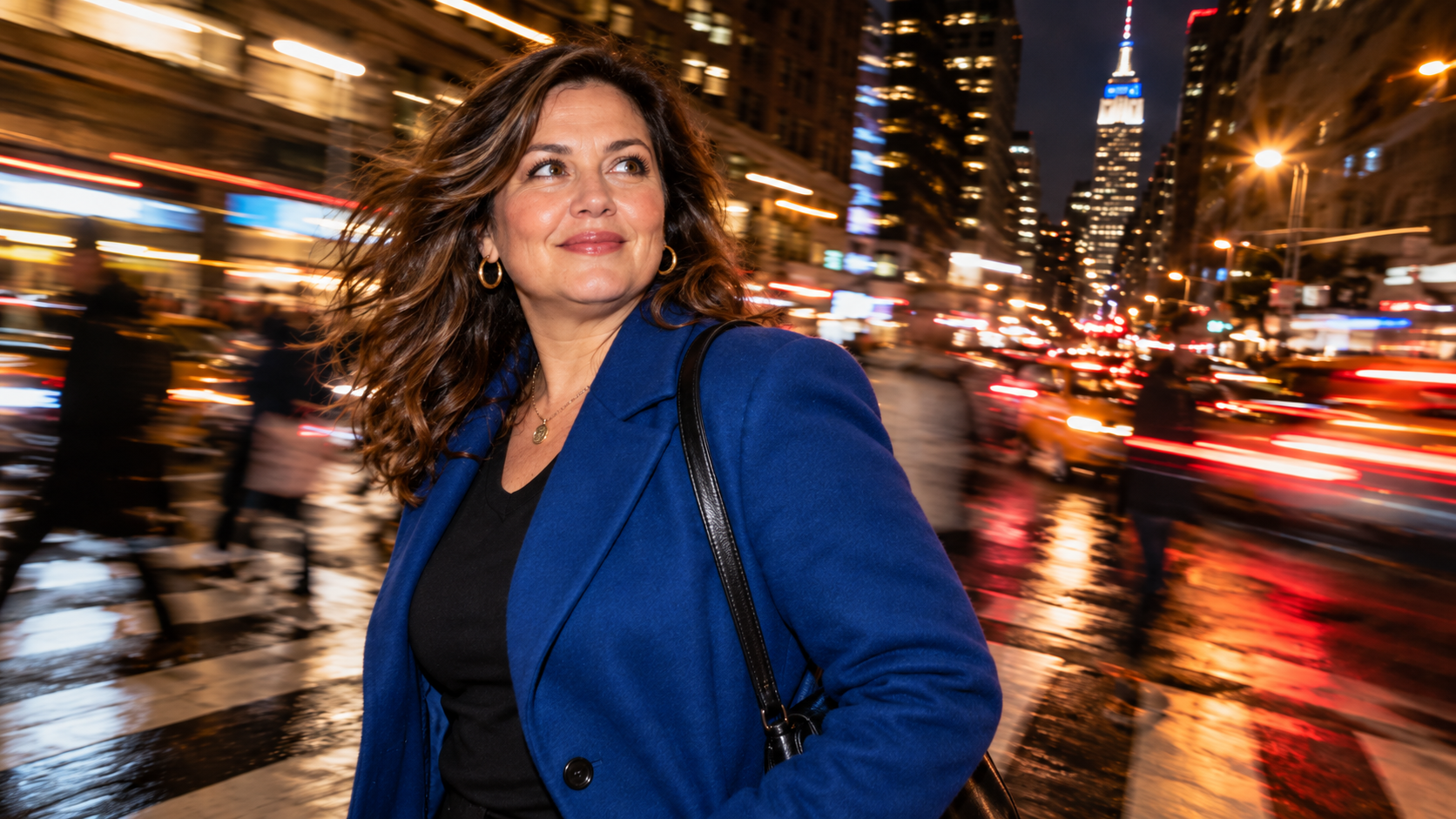
An ordinary portrait freezes everything in the frame. A shutter-drag portrait does something much more interesting: it freezes the person but allows the surrounding world to keep moving.
A quick flash captures the subject’s expression, while a slow shutter records the glow and movement of the ambient scene. The resulting photograph can feel spontaneous, chaotic, and beautifully controlled all at once. It has the energy of a night out without relying on a filter or a generic cinematic grade.
Glass Portal Product Reveal Prompt
Create a premium, photorealistic product advertising image featuring [PRODUCT] appearing inside or directly in front of a freestanding portal made from thick, transparent optical glass. PRODUCT REFERENCE: [ATTACH PRODUCT REFERENCE PHOTO OR DESCRIBE EXACT PRODUCT]. ENVIRONMENT: [STUDIO / MODERN INTERIOR / CITY STREET / BEACH / OTHER]. LIGHTING AND TIME: [SOFT DAYLIGHT / GOLDEN HOUR / NIGHT PRACTICALS / OTHER]. CAMERA ANGLE: [EYE LEVEL / THREE-QUARTER / LOW ANGLE / CLOSE-UP]. BRAND COLORS AND ART DIRECTION: [OPTIONAL]. Preserve the product exactly: original silhouette, proportions, materials, color, finish, recognizable packaging, existing labels, and supplied brand marks. Do not redraw its design, change the lettering, invent extra logos, or distort its shape. Give it a confident hero position and real physical scale. The portal is one visible, upright slab or frame of substantial clear optical glass, not a glowing science-fiction doorway. Its thickness, polished edges, light transmission, and subtle internal reflections must be physically convincing. The surrounding environment continues naturally on both sides of the glass. Apply visual bending, magnification, compression, and lens-like displacement ONLY to the background as seen through the portal. The portions of the scene outside the glass should remain undistorted, so the boundary between normal reality and refracted reality is instantly understandable. The product itself should stay crisp, proportionate, and recognizable even when placed within the portal composition. Add restrained realistic optical effects: refracted lines, soft caustic light patterns, small spectral highlights or rainbow-edge dispersion where the sun strikes the glass, accurate reflections, natural contact shadows, and transparent layered depth. Every shadow and reflection must agree with the chosen lighting direction. The image should feel like an expensive physical product installation photographed for an editorial advertising campaign. Use deliberate negative space, sophisticated composition, real photographic depth, accurate perspective, rich but controlled materials, and a cohesive art direction. Make the glass interaction the unusual visual hook and the product the unmistakable focus. Do not create a magical void, neon energy ring, floating interface, implausibly warped product, duplicated object, random text, fake packaging copy, invented product features, watermarks, oversaturated flares, or exaggerated fantasy effects. If a logo or copy is not provided, leave it out. Final result: tactile, physically plausible optical-glass portal photography with precise environmental refraction and an intact hero product.
What This Prompt Creates
A premium hero product portrait built around a freestanding optical-glass portal. The glass is not a digital overlay or sci-fi gateway; it is a thick, physical object with realistic edges, reflections, subtle rainbow dispersion, and refracted background scenery. The product stays the visual anchor, with its existing shape, packaging, materials, and approved branding preserved.
This concept works for packaged goods, fragrance, headphones, shoes, beverage cans, cosmetics, accessories, and other visually recognizable products. It is useful for social promotions, campaign key art, website hero images, and concept boards.
How to Use It
Begin with a real product photo whenever accuracy matters. Replace [PRODUCT] with the product’s name or description and attach the reference image. Specify the exact environment, lighting, and camera angle. Keep the same product color, size, proportions, packaging, and labels; the surprise should come from the portal, not from redesigning the merchandise.
Choose a setting with useful lines or textures behind the glass—a storefront grid, architectural hallway, foliage, beach horizon, or colorful interior. These give the refraction something meaningful to bend. Keep the surrounding scenery clear enough that viewers can tell which section is distorted and which is not.
Ask for one physical glass object rather than multiple unrelated effects. The portal should have visible thickness, correct perspective, contact with the ground, and a light direction that explains its reflections and caustics.
Make It Your Own
Liquid Glass: Increase the smooth wave-like lensing inside a clear solid slab, as though the surrounding architecture were viewed through gently curved optical glass. Keep edges polished and physically plausible.
Multiple Portals: Add two or three aligned glass planes at different depths, each producing a slightly different controlled refraction of the same background. Leave the product unobscured.
Urban Installation: Place a towering slab in a modern street or storefront with distorted window grids, sidewalk reflections, and strong scale cues that make it feel like a real installation.
Miniature World: Stage a small product or tabletop product set inside a glass installation, with refracted tiny props and a precise studio macro-photography look.
Night Edition: Position the portal near practical street or showroom lights, letting distant points of light split into restrained color edges while the product stays crisp.
Tips for Better Results
Keep product identity non-negotiable. Explicitly instruct the model not to rewrite packaging, labels, logos, or materials.
The environment should bend only where viewed through the glass. If the entire photo is distorted, the portal stops reading as a physical optical object.
Use just enough chromatic dispersion and caustics to sell the glass. Heavy rainbow flares can overpower a premium product.
Make the installation structurally believable: consistent perspective, substantial glass edges, ground contact, and lighting that matches shadows and reflections.
Choose backgrounds with straight lines and repeated forms to reveal the optical bending more clearly. Avoid messy scenes where refraction is hard to distinguish.
What This Prompt Creates
This prompt builds an editorial fashion or lifestyle portrait with a sharply illuminated subject and deliberately streaked ambient surroundings. Colored city lights become continuous ribbons, moving crowds become translucent silhouettes, and the person closest to the flash remains easy to recognize.
The defining detail is the relationship between the two exposures: the flash creates a crisp subject; the slow shutter gives ambient light and movement time to register. The effect should be physically believable rather than resembling an AI smudge or random neon overlay.
How to Use It
Upload a reference image if you want to preserve someone’s face, then specify the wardrobe, location, mood, and ambient light colors. Choose a nighttime scene that contains real points of light and activity: storefronts, traffic, club exits, night markets, carnivals, or stage-adjacent hallways.
Keep the camera position and motion plausible. Ask for a controlled shutter drag rather than complete camera shake. The subject’s face should remain readable and sharp, while moving objects and the ambient lights form streaks around them.
Use the approximate 1/8 to 1/2-second shutter description as a creative guide, not a strict camera setting. The image must show one decisive flash-frozen portrait with physically believable motion accumulated around it.
Make It Your Own
Crosswalk Rush: One calm subject in direct flash while passing commuters and traffic become directional trails behind them.
Club Exit: Bright flash on a dressed-up portrait, colorful venue lights, blurred figures, and expressive after-dark fashion.
Night Market: Warm lanterns and shop bulbs form luminous curves while the subject and nearby textured clothing remain crisp.
Backstage Corridor: A musician or performer holds still while crew silhouettes and practical corridor lights record subtle motion.
Carnival Spin: Amusement rides and fairground bulbs trace circular trails around a flash-lit subject.
Tips for Better Results
Make the flash the reason the subject is sharp. A uniformly sharp subject cut out of a blurred photograph looks composited.
Use actual practical lights as the source for every streak. Avoid arbitrary laser ribbons, special effects, or color clouds.
Keep blur direction coherent. A little controlled camera rotation or sideways movement produces more believable trails than chaotic motion in every direction.
Protect the eyes. Let the face remain the dominant crisp focal point; reserve translucent ghosting for the silhouette edges and background movement.
Avoid overdoing film grain, timestamps, and retro borders. Unlike disposable-camera or 2000s phone styles, this concept is defined by shutter behavior, not nostalgia.
When generating a carousel, maintain the same subject styling and practical lighting logic across images, but vary framing and settings to show different applications.Do not ask AI to invent new marketing copy. Add your exact campaign wording in design software after generating the image if the text must be precise.