
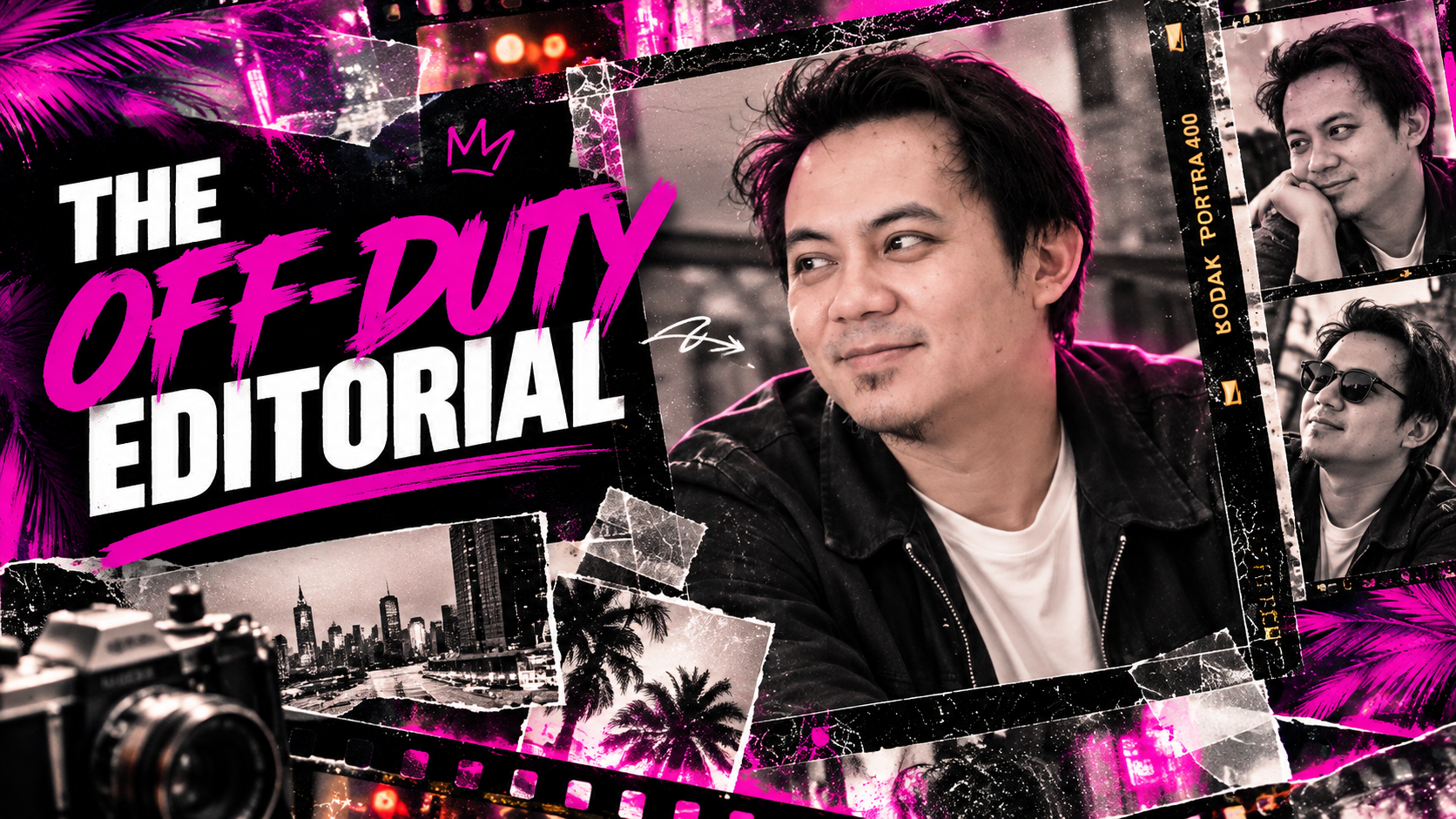
You know those street-style photos that look as though they happened by accident? Someone stepping out of a café, taking a break on a concrete step or looking toward a friend just outside the frame. The clothes have personality, but the moment feels effortless. That is what makes an off-duty editorial so compelling.
The Off-Duty Editorial turns a regular reference portrait into an image with the energy of an independent fashion magazine. Instead of making someone pose like a model, this AI photography prompt focuses on natural body language, believable surroundings, practical lighting and clothing that looks genuinely worn. The goal isn’t to look expensive; it’s to look interesting.
The Off-Duty Editorial
Create one highly realistic CANDID STREET-STYLE EDITORIAL PHOTOGRAPH titled “The Off-Duty Editorial.” Photograph an ordinary adult in an everyday urban setting with effortless personal style, a relaxed expression, and natural physical presence. The image should feel like an unplanned frame captured by a skilled independent-magazine photographer, not a posed studio fashion campaign, luxury advertisement, illustration or 3D render. SUBJECT / REFERENCE: [Upload one clear, authorized reference photograph or describe an original adult subject.] When a reference image is supplied, keep the person unmistakably recognizable, preserving facial shape, age, natural skin texture, hairstyle and subtle facial hair. Example: a dark-haired adult man with a faint goatee, an easy half-smile and understated off-duty style. WARDROBE: [A worn-in black denim jacket or overshirt, plain white T-shirt, dark casual trousers and comfortable neutral shoes.] The clothing should have believable seams, fabric thickness, folds and natural wear. No fabricated brand logos. SETTING: [Downtown sidewalk / café exterior / concrete staircase / quiet venue entrance / unpolished neighborhood street.] Show real perspective, practical urban details and subtle atmosphere without an extravagant set. ACTION: [Resting a hand on a knee / sitting casually on a low step / adjusting a jacket cuff / turning toward a friend’s voice / stepping away from a café.] Capture the action in progress, not a completed model pose. LIGHTING: [Natural soft daylight / restrained direct on-camera flash at dusk / high-contrast black-and-white available light]. Choose one physically coherent approach. CAMERA: [35 mm documentary view or 50 mm relaxed portrait], eye-level or slightly lower, with realistic depth of field and a spontaneous, asymmetrical composition. OUTPUT: [4:5 editorial portrait / 3:4 fashion lookbook / 16:9 landscape crop]. Keep important facial features and hands fully visible, and allow useful negative space for later typography. Frame the person as someone with a life beyond the photo. Their shoulders are relaxed and their gaze is directed naturally at the photographer or something just outside the frame. Both eyes and pupils must be aligned toward the same plausible point, never crossed or drifting. The pose should show natural body weight, anatomically correct hands, realistic shoulder angles and convincing contact with the seat, wall, step or ground. Treat direct flash realistically if selected: a small near-camera light source that gives the face and clothing a crisp foreground exposure, natural highlights in the eyes and fabric, coherent short shadows on nearby surfaces, and gentle falloff into a darker street. It should resemble a genuine late-1990s or early-2000s street-style snapshot, not colored studio rim lighting. If selecting daylight or monochrome, preserve rich tonal separation between skin, black jacket and white shirt, with restrained grain and believable highlight roll-off. Include subtle everyday details such as a weathered wall, street sign in soft focus, worn pavement, old doorframe or passing pedestrians. Keep buildings aligned with a credible camera perspective. Background figures should be unique, proportionate and naturally placed. Avoid advertising props and attention-grabbing fake signage. Make the wardrobe and textures tactile: slight creases at the elbows, real cotton weave, faded denim texture, subtle flyaway hair and naturally detailed skin. The image should feel stylish because of the person’s confidence and the photographer’s timing—not because of artificial glamour. No excessive smoothing, sharpened halos, unreal bokeh, fake film damage covering the face or aggressive cinematic color grading. Create a SINGLE completed photographic image only. Do not add typography, film strips, neon brushwork, torn-paper borders, contact sheets, logos or watermarks inside this base photo. Those graphic design elements can be composited separately for the featured image or carousel. STRICT QUALITY CHECK: true likeness to the reference; coherent eye direction and pupils; accurate fingers, teeth, anatomy and clothing construction; believable shadow direction, reflections and architecture; no duplicated people, extra limbs, distorted eyes, warped jackets, overly edited skin, CGI sheen or embedded text. The result should be an authentic, understated off-duty fashion photograph.
What This Prompt Creates
A realistic editorial street portrait built around one recognizable person and an ordinary city setting. The subject might wear a black overshirt, a clean white tee and dark trousers while leaning against a wall or sitting outside a café. The camera catches an unguarded expression rather than a runway pose. Direct on-camera flash, soft daylight or restrained monochrome film treatment can each create a different mood. Use it for creative personal branding, musician profiles, lookbooks, editorial mood boards and social content.
Why It Works
An authentic street-style photograph feels both observed and composed. The camera finds a strong angle, but the subject is still busy being a person: adjusting a sleeve, waiting for someone or looking over a shoulder. Small movements make the picture feel lived-in.
On-camera flash can add that candid independent-magazine quality. Its concentrated light brings out the texture of a jacket and separates a person from the street behind them. It should behave like a real flash, though—not arbitrary neon rim lighting or glamorous studio illumination.
How to Use It
1. Upload a clear photo of the person, with their permission, or describe an original adult subject. Preserve their recognizable facial structure, natural age, hairstyle and expression.
2. Choose an ordinary environment such as a café entrance, sidewalk, concrete wall, venue exit or urban staircase.
3. Give the subject one small action: fixing a jacket cuff, resting a hand on a knee, glancing toward someone or standing between steps.
4. Select direct flash, subdued color-negative film or crisp black-and-white. Choose a realistic 35 mm or 50 mm documentary camera view.
5. Copy the full prompt below into your image generator. Review likeness, eye alignment, fingers, fabric detail, shadow direction and environment perspective.
6. Add any bold headline, film strip, torn paper or magenta graphic treatment afterward in your design software. Keep the generated base photo clean.
Make It Your Own
• After-Hours Flash — A creative leaving a small venue at night with direct flash and soft city lights behind them.
• Sidewalk Sunday — A simple white tee and dark jacket on an overcast sidewalk, photographed with unguarded body language.
• The Monochrome Edit — A quiet black-and-white portrait with concrete textures and restrained grain.
• Off-Camera Conversation — The subject smiles toward someone beside the photographer while seated on an outdoor step.
• Travel-Day Uniform — A candid moment near a station entrance, with casual layers and a realistic bag.
• Analog Contact Sheet — Make several distinct photographs of the same person, then assemble the contact-sheet layout separately.
Tips for Better Results
• Describe a specific action instead of asking for a “cool pose.”
• Keep the person recognizable, including small facial features, age and natural skin texture.
• Make both eyes look naturally toward the same point; check any face-reference generation for gaze errors.
• If using direct flash, specify coherent shadows, natural highlight falloff and an ordinary camera angle.
• Keep wardrobe believable: real folds, realistic stitching and comfortable proportions.
• Preserve negative space around the face and hands so graphic treatments can be added without covering them.
• Generate one photo first, then add film strips and magazine-style typography in post-production.
• Avoid invented designer logos, excessive beauty retouching and artificial CGI smoothness.
• Do not present a generated scene as documentation of a real event.